
7 Business Lessons Every Healthcare Professional Should Know Before Starting a Business

Have you ever looked around your workplace and thought, "I know I was meant for something bigger than working shift after shift?"
I know that feeling because I've lived it.
As a board-certified Family Nurse Practitioner, Army veteran, and entrepreneur, I spent years caring for patients before realizing that my ability to help people didn't have to stop inside an exam room. Today, I've had the privilege of building multiple purpose-driven businesses, including Walker Wellness & Aesthetics Clinic, The Scalp Boss, and my coaching programs for aspiring entrepreneurs.
If there's one lesson I've learned, it's this:
Being an exceptional healthcare provider does not automatically prepare you to become a successful business owner.
Clinical excellence earns trust. Business knowledge creates freedom.
That's exactly why I wanted to write this article. If you're thinking about becoming a healthcare entrepreneur, I want to help you avoid many of the mistakes I made while building my businesses. Entrepreneurship has given me the opportunity to create greater impact, serve more people, build multiple income streams, and design a life aligned with my purpose but it required learning an entirely new set of skills.
If you'd like to learn more about my journey, visit my About page to see how my experiences in healthcare, military service, and entrepreneurship shaped the businesses I lead today.
Let's dive into the seven biggest lessons I believe every healthcare professional should know before taking the leap.
Why More Healthcare Professionals Are Becoming Entrepreneurs
Healthcare has changed dramatically over the past decade. More physicians, nurse practitioners, nurses, therapists, pharmacists, and allied health professionals are discovering that entrepreneurship offers opportunities beyond traditional employment.
Some want greater flexibility, others want to solve problems they've witnessed firsthand in healthcare. Many simply want the freedom to build something of their own while increasing their income and creating a lasting legacy.
I've met countless healthcare professionals who have incredible clinical knowledge but underestimate how valuable that expertise can become outside of a traditional workplace.
Being a healthcare business owner isn't just about opening a clinic anymore. Today, healthcare professionals are launching coaching businesses, consulting firms, wellness brands, educational platforms, digital products, memberships, and online courses.
The opportunities are larger than ever but success requires thinking differently.
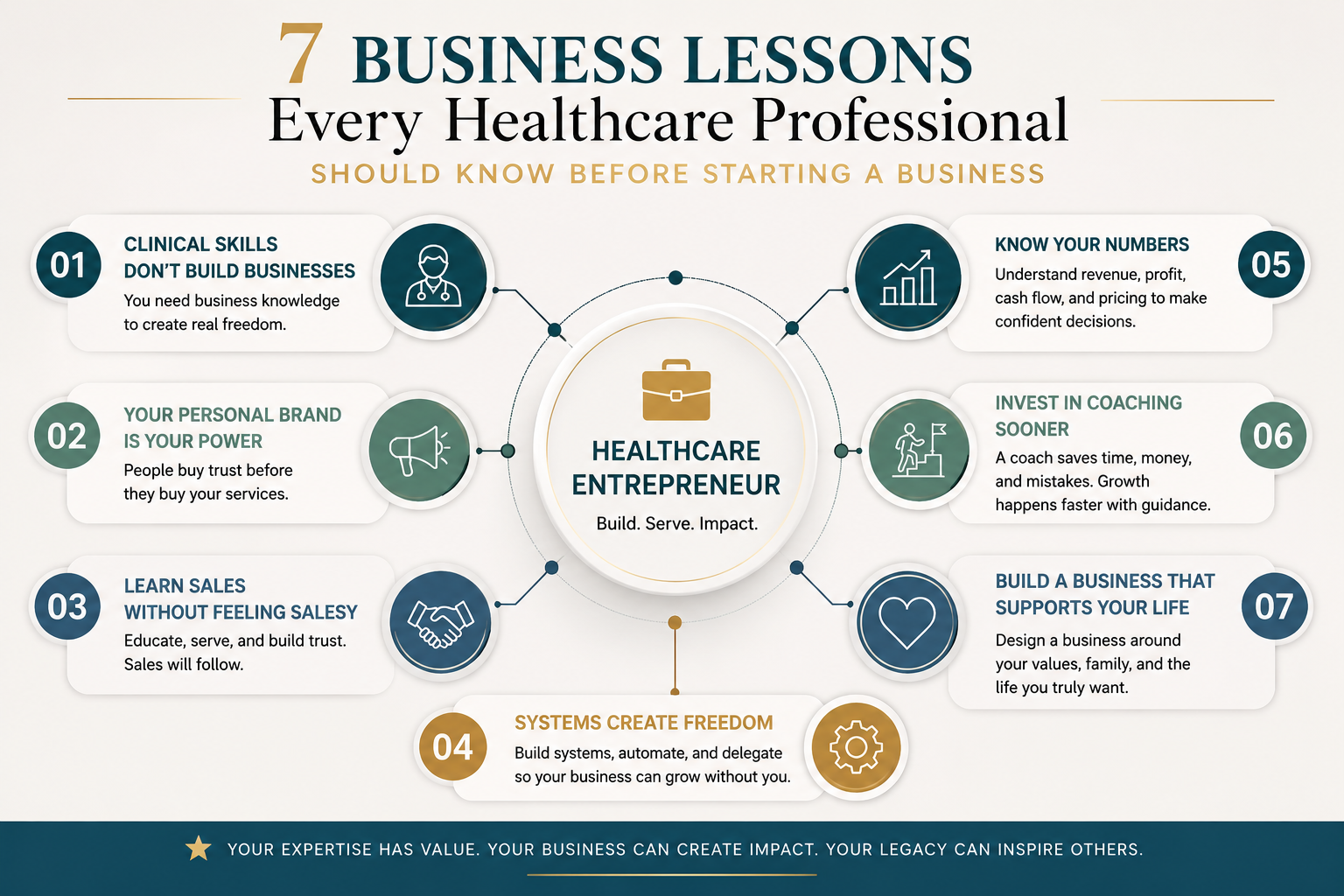
7 Business Lessons Every Healthcare Entrepreneur Should Learn
1. Clinical expertise is only half the equation
Your education prepared you to care for patients, not necessarily to understand marketing, accounting, operations, hiring, branding, or sales. Those are skills you'll need to intentionally develop.
2. Your personal brand matters more than you think
People don't simply buy healthcare services. They buy trust. Showing your expertise consistently through education, speaking, content creation, and authentic storytelling helps people feel confident choosing you before they ever become clients.
3. Learn to sell by serving
Many healthcare professionals feel uncomfortable with sales because they associate it with pressure. I learned that the best marketing simply educates people. When you solve problems and provide value, sales become a natural outcome of trust.
4. Systems create freedom
Early in my entrepreneurial journey, I tried doing everything myself. Eventually I realized sustainable growth requires documented processes, automation, delegation, and efficient systems that allow your business to operate without depending on you every minute.
5. Know your numbers
Revenue is exciting, but profit keeps your business alive. Understanding pricing, expenses, cash flow, and financial planning helps you make confident business decisions instead of emotional ones.
6. Invest in coaching sooner rather than later
Looking back, I wish I had invested in mentorship earlier. A coach shortens your learning curve, helps you avoid expensive mistakes, and provides accountability when uncertainty sets in. That's one reason I created my business coaching programs to help healthcare professionals move from idea to action with clarity and confidence.
7. Build a business that supports your life not one that consumes it
Entrepreneurship should create freedom, not another demanding job. Design your business around your values, your family, your goals, and the lifestyle you truly want.
Can Nurses Become Entrepreneurs?
Absolutely.
In fact, nurses often possess many of the qualities that make outstanding entrepreneurs.
Throughout my nursing career, I learned to solve problems under pressure, communicate effectively, educate patients, lead multidisciplinary teams, and make important decisions quickly. Those same skills have become invaluable in business.
Being a nurse entrepreneur doesn't always mean opening a private practice. Some nurses build educational platforms, launch wellness brands, develop digital products, become consultants, create coaching businesses, or invent healthcare innovations.
Your license isn't your limitation.
It's often your greatest competitive advantage.
People trust healthcare professionals because they recognize the knowledge and experience behind the credentials. When combined with strong business fundamentals, that trust becomes incredibly powerful.
How Do Healthcare Professionals Start a Business?
One of the questions I receive most often is:
"How do healthcare professionals actually start a business?"
The answer is simpler than many people think but it does require intentional planning.
Start by identifying a specific problem you want to solve, the best businesses are built around real problems experienced by real people.
Next, validate your idea. Talk to potential customers before investing thousands of dollars into branding or websites, make sure people actually want the solution you're planning to offer.
Then begin building your personal brand. Share educational content, speak at events, network with other professionals, and establish yourself as a trusted authority in your niche.
You'll also need to understand the legal and regulatory requirements that apply to your profession, create a clear service or product offering, develop a marketing strategy, and implement systems that allow your business to grow efficiently.
One of the biggest mistakes I see is waiting until everything feels perfect.
Perfection rarely comes before action.
The most successful healthcare entrepreneurs start, learn, adjust, and improve as they grow.
The Biggest Mistakes I See New Healthcare Business Owners Make
After mentoring entrepreneurs and building several businesses myself, I've noticed the same patterns repeatedly.
Many healthcare professionals spend years thinking about starting a business but never actually begin, fear of failure, uncertainty, and perfectionism keep them stuck.
Others underestimate marketing, they believe that because they're highly qualified, customers will naturally find them.
Unfortunately, that's rarely how business works.
People can't hire someone they've never heard of.
I also see many new entrepreneurs trying to do everything alone. While independence is admirable, isolation often slows growth. Building relationships with mentors, coaches, and business communities can dramatically accelerate your progress.
Finally, I encourage healthcare professionals to stop undervaluing their expertise.
You've spent years developing specialized knowledge.
That expertise has tremendous value not only in patient care but also in education, consulting, speaking, coaching, and business ownership.
Your Expertise Is More Valuable Than You Think
If you're waiting for someone to give you permission to start your business, consider this your sign.
Healthcare professionals already possess one of the hardest parts of entrepreneurship: expertise.
Business skills can be learned.
I've learned that success doesn't come from knowing everything before you begin. It comes from taking consistent action, staying teachable, and surrounding yourself with people who have already walked the path.
Whether you're dreaming of launching a clinic, creating a digital product, starting a coaching business, or becoming a full-time healthcare entrepreneur, remember that your experience has the power to change lives far beyond your current workplace.
If you're ready to accelerate your entrepreneurial journey, I'd love to help. Through my coaching programs, I work with aspiring and established healthcare professionals who want to build purpose-driven businesses with confidence.
When you're ready to take the next step, please get in touch. Together, we can create a business that not only serves others but also creates the freedom, impact, and legacy you deserve.
Frequently Asked Questions
How do healthcare professionals start a business?
Start by identifying a problem you want to solve, validating your business idea, understanding legal requirements, building your personal brand, and developing systems for marketing and operations. Seeking guidance from experienced mentors can significantly shorten the learning curve.
Can nurses become entrepreneurs?
Absolutely. Nurses possess leadership, communication, critical thinking, and problem-solving skills that translate exceptionally well into business ownership. Many successful nurse entrepreneurs operate clinics, consulting firms, wellness brands, coaching businesses, and educational platforms.
What businesses can healthcare professionals start?
Healthcare professionals can build private practices, wellness clinics, consulting firms, coaching businesses, online education platforms, digital products, healthcare technology companies, memberships, and product-based businesses.
Do I need an MBA to become a healthcare entrepreneur?
No. While business education is valuable, many successful healthcare entrepreneurs develop their business knowledge through coaching, mentorship, continuing education, books, and practical experience.
Is owning a healthcare business profitable?
It can be. Profitability depends on factors such as your business model, pricing strategy, marketing efforts, operational efficiency, and ability to consistently provide value to your target audience. Careful planning and sound financial management are essential for long-term success.
The U.S. Small Business Administration's business planning resources are an excellent reference for creating a business plan and understanding the fundamentals of starting and growing a business.
*****
About the Author
Taneka Walker, MBA, MSN, APRN, FNP-C
I'm a board-certified Family Nurse Practitioner, veteran, entrepreneur, educator, and founder of multiple purpose-driven businesses. My mission is to help women, veterans, and entrepreneurs build health, wealth, and confidence by transforming their expertise into meaningful opportunities and sustainable income streams. Through coaching, education, and mentorship, I help aspiring entrepreneurs turn experience into impact and income.
